



Ready vs Custom eCommerce Platforms: How to Choose in 2026?

Arup Sarkar
12 Jan 2026
Share on


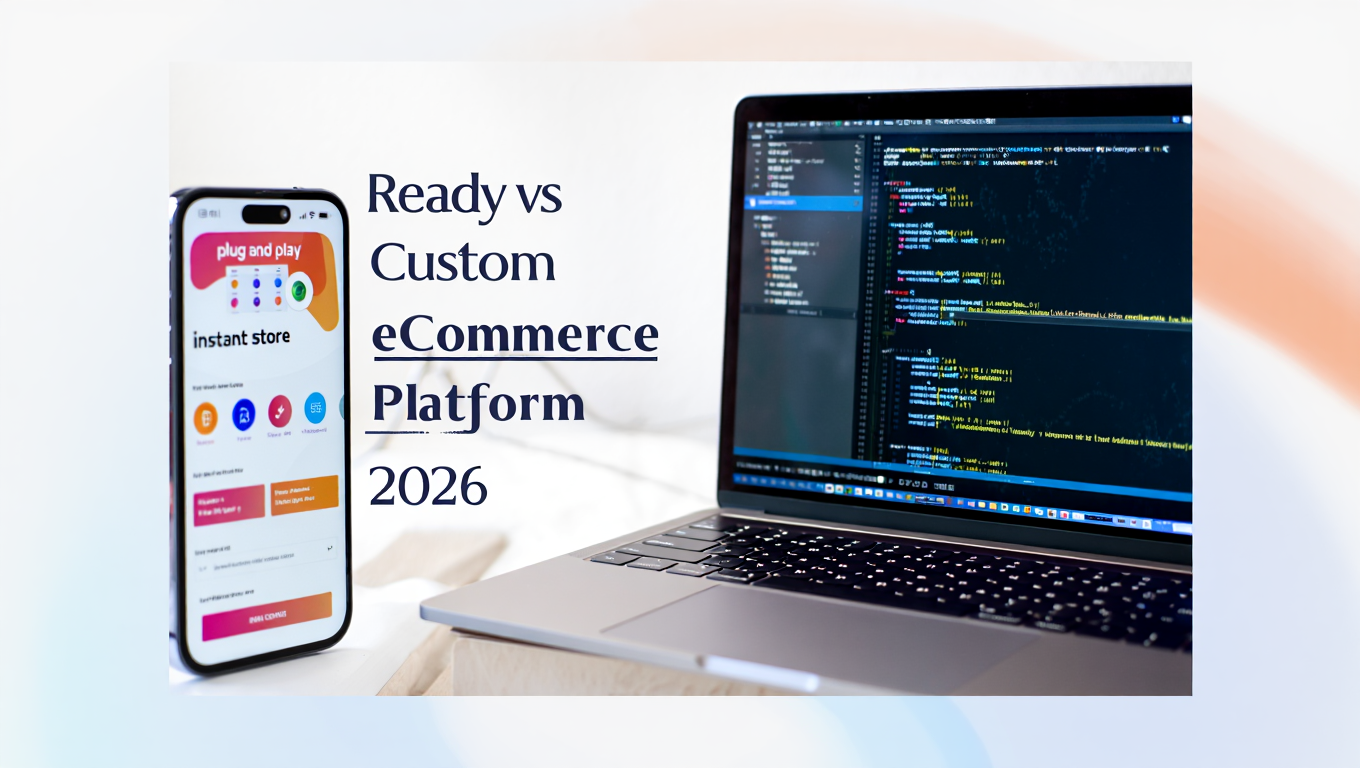
Choosing between a ready-made eCommerce platform and a Custom eCommerce Platform in 2026 is no longer a purely technical question—it is a strategic business decision that directly affects growth, profitability, and long-term control.
In 2026, many founders, CTOs, and decision-makers face the same situation. You want to launch or scale an eCommerce business quickly, but you also want flexibility, ownership, and freedom from hidden platform costs. SaaS tools often feel restrictive once real growth begins. Fully custom development, on the other hand, feels risky, expensive, and slow.
Somewhere in between, ready-made eCommerce kits like RazinSoft’s have emerged as a serious alternative—combining speed, ownership, and customization without the overhead of building everything from scratch.
This guide is written from the perspective of someone who has built, scaled, and optimized eCommerce systems, not just installed templates. We will walk through real-world tradeoffs, cost structures, scalability concerns, and future-proof architecture in plain language, supported by practical examples and calculations.
By the end of this guide, you will know exactly which path fits your business model in 2026—and why.

Before comparing RazinSoft’s kit with fully custom development, it is important to clearly understand the three dominant eCommerce models available today and what they realistically offer in long-term scenarios.
1. Ready eCommerce Platform (Self-Hosted Kits)
A ready eCommerce platform is a pre-built, production-ready system that already includes core commerce logic such as products, carts, checkout, order management, inventory, and admin dashboards.
RazinSoft’s solution falls into this category.
Key characteristics include:
- One-time license cost with no recurring platform fees
- Full source code ownership
- Customizable features without vendor lock-in
- Ability to launch in weeks instead of months
- Control over hosting, performance, and data
This model is especially appealing to businesses that want speed without sacrificing ownership.
2. Fully Custom eCommerce Development
Fully custom development means building everything from the ground up—database schema, backend logic, frontend interfaces, APIs, integrations, and admin workflows.
Key characteristics include:
- Maximum flexibility and control
- Highest upfront development cost
- Long timelines, often 6–12 months
- Ongoing maintenance and security responsibility
- Dependence on specialized development teams
While powerful, this approach is only justified when the business model itself requires unique system behavior.
3. SaaS Platforms (Shopify, BigCommerce)
SaaS platforms are popular for fast launches, but they introduce limitations as businesses grow. Monthly fees, transaction costs, app dependencies, and restricted backend access often become long-term obstacles.
This article focuses instead on Self-Hosted eCommerce vs SaaS, where RazinSoft competes strongly by offering ownership and flexibility without SaaS constraints.

One of the most important architectural shifts shaping this decision is Headless Commerce Architecture.
What Headless Commerce Really Means
In a headless setup:
- The backend handles products, orders, customers, payments, and inventory
- The frontend is decoupled and can be web, mobile app, POS, or other interfaces
- APIs connect all components
This separation allows businesses to innovate on the customer experience without rewriting the backend logic.
Why This Matters in 2026
Modern consumers expect:
- Fast mobile apps
- Progressive web apps
- In-store digital experiences
- AI-driven personalization
Fully custom systems can support headless architecture—but building it correctly requires significant expertise and cost.
RazinSoft’s ready kit is headless-ready, meaning APIs are already structured, frontends can be extended independently, and mobile or web experiences can evolve without rebuilding the system. This dramatically reduces technical risk while preserving long-term flexibility.

A common mistake in platform selection is ignoring the developer ecosystem behind the technology.
Searching for a Laravel eCommerce Solution is not accidental. Laravel has become one of the most trusted frameworks for scalable, secure web applications.
Why Laravel Dominates Custom and Enterprise Builds
Laravel offers:
- Proven security architecture
- Clean MVC structure
- A massive developer ecosystem
- Long-term maintainability
- Easy onboarding for new developers
RazinSoft vs Fully Custom Laravel Builds
| Factor | RazinSoft Kit | Fully Custom |
| Base Architecture | Pre-engineered | Built from zero |
| Security | Tested patterns | Depends on team |
| Time to Market | 2–4 weeks | 6–9 months |
| Hiring Developers | Easy | Easy |
The difference is not Laravel itself—it is how much of the groundwork is already done and tested.

Many businesses searching in 2026 are not launching simple online stores. They want full Multi-Vendor Marketplace Platform capabilities similar to Amazon or Etsy.
These typically include:
- Vendor dashboards
- Commission logic
- Seller payouts
- Product moderation
- Vendor analytics
The Real Cost of Multi-Vendor Complexity
In fully custom builds, multi-vendor functionality requires:
- Separate user role systems
- Financial ledger tracking
- Commission calculation logic
- Approval and dispute workflows
This complexity often adds 30–40% more development time.
RazinSoft’s multi-vendor support is built-in, meaning vendor onboarding, commission rules, and admin oversight exist from day one. This can save months of development and reduce risk significantly.

Most founders underestimate eCommerce Total Cost of Ownership (TCO) by focusing only on initial development.
A more realistic formula is:
TCO = Development Cost + Hosting + Maintenance + Scaling + Fees
Example 1: Fully Custom Platform (3 Years)
- Development: $60,000
- Maintenance: $1,500/month × 36 = $54,000
- Scaling and fixes: $20,000
Total TCO ≈ $134,000
Example 2: SaaS Platform (3 Years)
- Platform fees: $300/month × 36 = $10,800
- Transaction fees (2% on $1M revenue): $20,000
- Apps and upgrades: $15,000
Total TCO ≈ $45,800
(With zero ownership)
Example 3: RazinSoft Ready Kit
- One-time license fee: $39
- Hosting and maintenance: Depends on your budget; the platform can be reliably operated for approximately $100–$500 per year on standard hosting
Total TCO ≈ $199–$539
(With full ownership and control)
This cost clarity is why many decision-makers prefer self-hosted ready kits.
Fully custom development is justified in specific scenarios:
- Extremely unique business logic
- Heavily regulated industries
- Proprietary algorithms that drive revenue
However, over 80% of businesses do not need full custom platforms.
RazinSoft’s kit reduces Custom eCommerce Development Cost by:
- Eliminating core system rebuilds
- Allowing selective customization
- Preventing over-engineering
You customize what matters—without paying for what does not.
Omnichannel Retail Software: Online Meets Offline
Modern commerce is not single-channel. Customers expect seamless experiences across platforms.
What Omnichannel Means in Practice
- Website and mobile app synchronization
- Inventory syncing with POS systems
- Unified customer profiles and order history
If your platform cannot support this, growth eventually stalls.
Because RazinSoft is self-hosted and API-driven, it can function as true Omnichannel Retail Software, acting as a central backend for online, offline, and mobile sales channels.
AI eCommerce Integration: Practical, Not Hype
AI is no longer optional in 2026—it is a competitive necessity.
Real AI Use Cases in Commerce
- Product recommendations
- Search personalization
- Chat-based shopping assistants
- Demand forecasting
Closed SaaS platforms often restrict AI experimentation. With RazinSoft’s architecture, AI models can be integrated directly into APIs and workflows without vendor permission.

More than 75% of eCommerce traffic now comes from mobile devices.
A true Mobile-First eCommerce Platform must support:
- Native mobile apps
- Flutter-based development
- Fast API response times
RazinSoft enables mobile expansion without rewriting backend logic, making it ideal for long-term mobile growth.
Enterprise eCommerce Scalability: Thinking Beyond Today
Growth exposes weak systems.
True Enterprise eCommerce Scalability requires:
- Optimized database schemas
- Queue-based background processing
- Intelligent caching strategies
- Ability to handle millions of SKUs
RazinSoft’s database structure is designed to scale progressively, allowing businesses to grow without costly rebuilds.

Example 1: Startup Marketplace
Goal: Launch in 60 days
Budget: Limited
Need: Multi-vendor support
Best choice: RazinSoft Ready eCommerce Kit
Example 2: Mid-Size Retail Brand
Goal: Omnichannel expansion
Need: POS integration and mobile app
Budget: Medium
Best choice: RazinSoft Kit with customization
Example 3: Enterprise with Unique Logic
Goal: Proprietary workflows
Budget: High
Timeline: Flexible
Best choice: Fully Custom Development
Frequently Asked Questions
Is a ready eCommerce kit secure for long-term use?
Yes. When built on a Laravel eCommerce Solution, security best practices and updates are well-established.
Can RazinSoft scale like a custom platform?
Yes. Scalability depends on architecture, not origin. RazinSoft supports enterprise-level growth.
Will I be locked into RazinSoft?
No. You own the source code and infrastructure, unlike SaaS platforms.
Conclusion
Choosing between a ready eCommerce platform and fully custom development in 2026 is about strategic efficiency, not just technology.
- Fully custom offers control—but at high cost and risk
- SaaS offers speed—but limits ownership and scalability
- RazinSoft’s ready kit offers a balanced, future-proof middle ground
If your goal is to launch faster, control costs, scale intelligently, and remain flexible, a headless-ready, self-hosted solution is often the smartest choice.
Explore your requirements carefully, model your TCO honestly, and choose the platform that serves your next five years—not just your launch.
List of Contents
A Practical Comparison of RazinSoft’s Ready eCommerce Kit vs Fully Custom Development
Understanding the Three eCommerce Paths in 2026
Headless Commerce Architecture: The Defining Trend of 2026
Laravel eCommerce Solution: Why Technology Choice Matters
Multi-Vendor Marketplace Platform: Amazon-Like Complexity
eCommerce Total Cost of Ownership (TCO): The CFO View
Custom eCommerce Development Cost: When Is It Justified?
Mobile-First eCommerce Platform: Where Sales Actually Happen
Step-by-Step Decision Examples
